It felt like the right time to sort out my ageing website; bytesizeadventures.com. It's something that I created way back in 2009 as a vehicle for my iPhone development. Things have changed since then and I find myself wanting more of a personal journal for my various interests - hence chriswaite.dev is born.
I've ported all of my posts from Bytesize Adventures over to this new website which lives on a much simpler technical stack. It's simply a set of html and css files living on Github Pages. I had several drivers for making this technical change:
Complexity
Bytesize Adventures was fairly complex. It was a WordPress CMS exposing content via the REST API to a NextJS frontend. The two were hosted separately. This was a great learning experience and I believe in both WordPress and NextJS as excellent platforms for building interactive interfaces on the web.
For a personal website though, these were overkill. Primarily they place a large maintenance burden on you to keep them patched and updated, sometimes requiring large code changes to keep up with the latest releases. It was simply too much to take on in the small amount of free time I have - time better put to use on other projects. This new website effectively has zero maintenance with any changes determined by my own priorities.
Ownership
This is becoming increasingly important to me. The posts I made on Bytesizeadventures represented a significant portion of my life and so they mean something to me. I'd like to ensure that I retain control of them in a way that means I can access them easily. Burying them in a database requiring specific software to extract doesn't feel great. A set of flat html files stored in a repository feels much better and allows me to replicate and back them up with minimal fuss.
AI
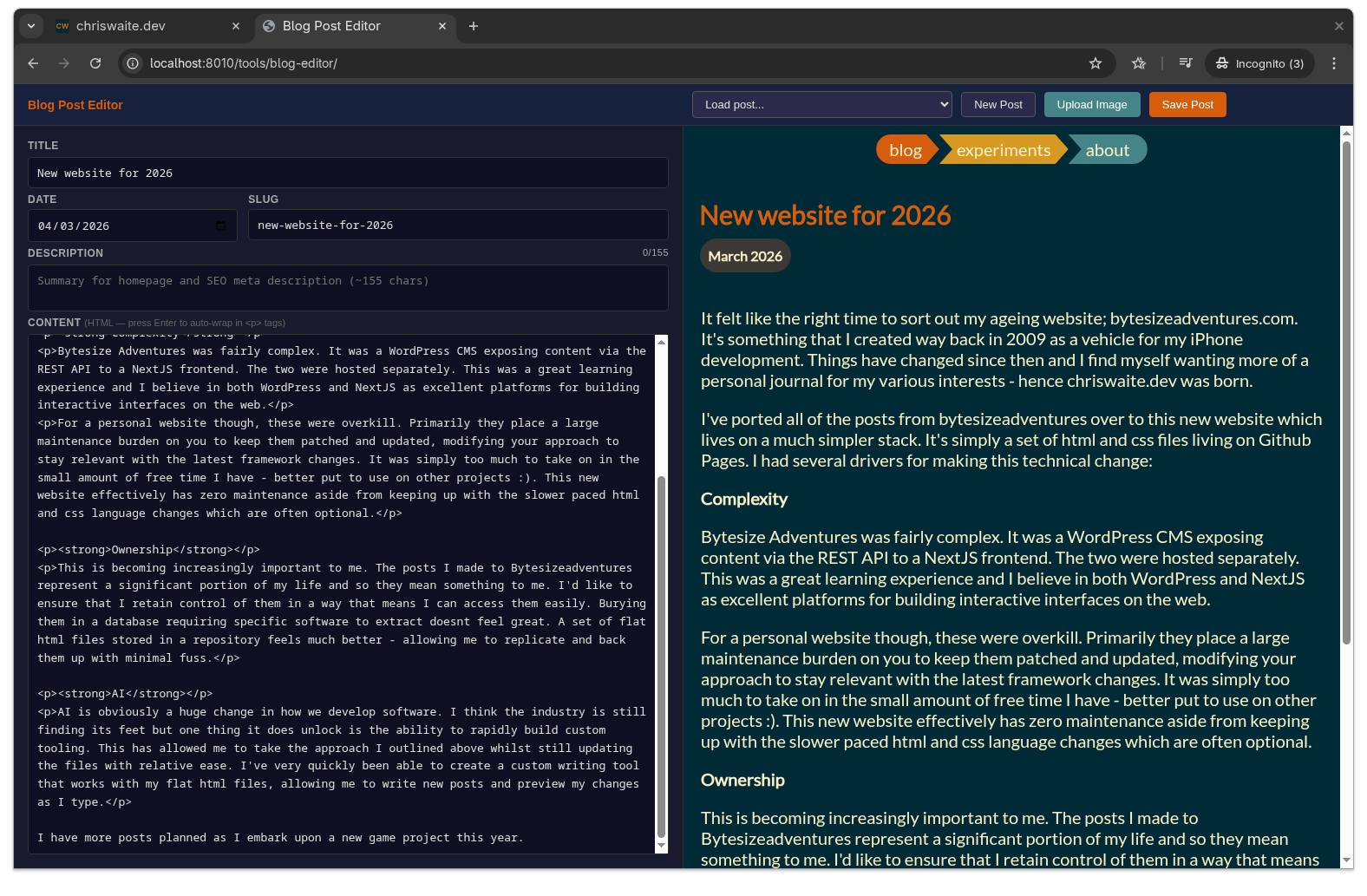
AI is obviously a huge change in how we develop software. The industry is still finding its feet but it is already bringing some benefits. One such benefit is the ability to rapidly build custom tooling. This has allowed me to take the approach I outlined above whilst still updating the files with relative ease. I've very quickly been able to create a custom editing tool that works with my flat html files, allowing me to write new posts and preview my changes as I type. All running locally with minimal dependencies.